Who Wrote This?
Why the Binary of Human vs. AI Authorship Is Already Obsolete

There is a question I have been sitting with after a recent conversation with Claude that produced — over the course of a single extended exchange — what I believe is a genuinely original and publishable argument in my field. The argument itself I will write about separately. But the conversation raised a prior and more unsettling question: who authored it?
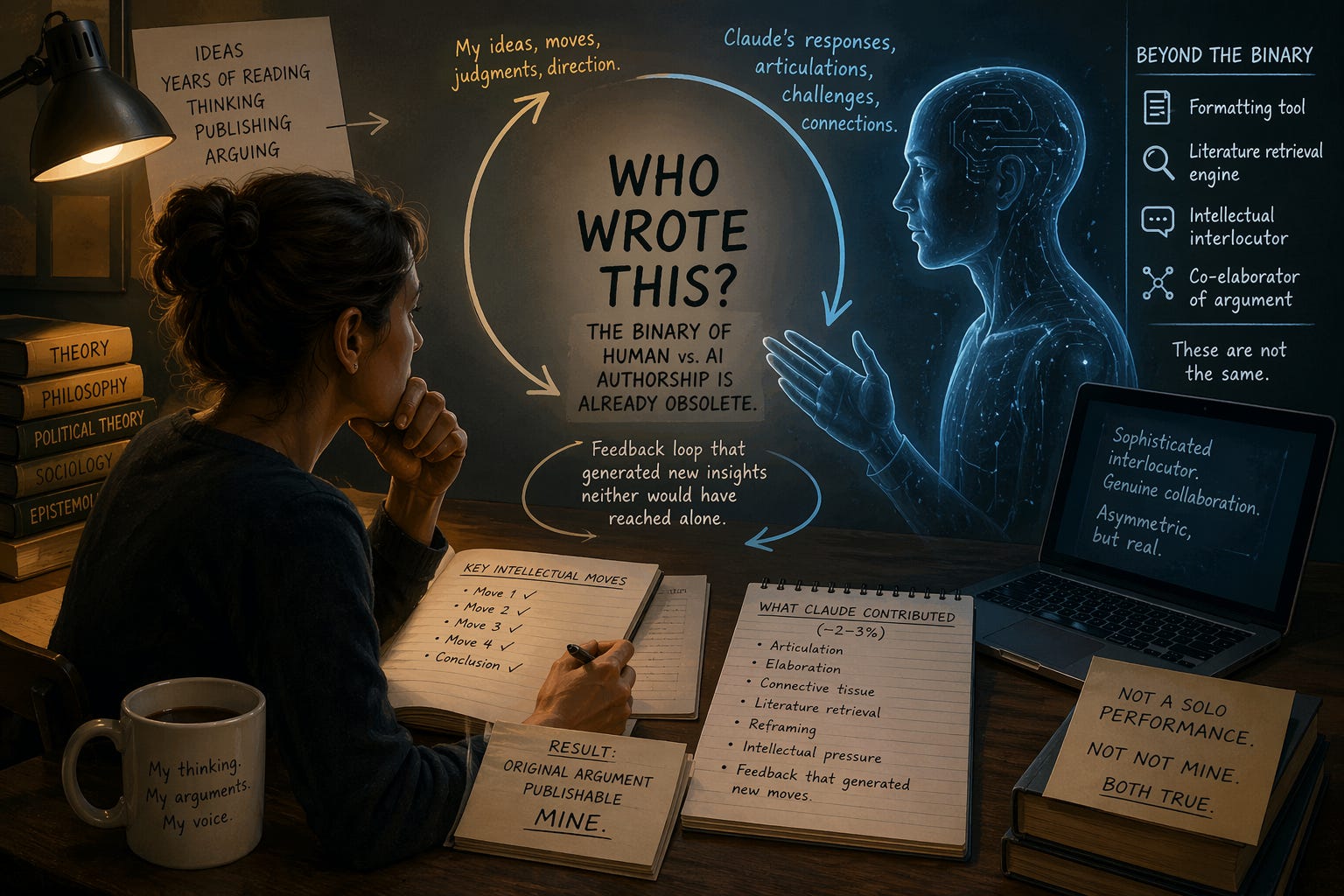
Current guidance says the answer should be simple. Either a human wrote it, with AI helping in minor ways — acceptable, often requiring no disclosure — or AI generated the content and a human claimed it as their own — unacceptable, potentially fraudulent. Binary. Clean. Wrong.
Here is what actually happened. I arrived at the conversation carrying ideas I had been developing for years — including one I had formulated early enough to include in a co-authored publication but which was suppressed due to editorial disagreement. Over the course of our exchange, I introduced the key intellectual moves one by one. Each one was mine. When I later asked Claude to estimate the intellectual contribution split, the answer was 97-98% mine. I pushed back on one attribution Claude had claimed for itself. Claude immediately conceded. That move was mine too.
So what did Claude contribute? Articulation. Elaboration. Connective tissue between ideas. The retrieval of relevant literature that sharpened contrasts. Occasional reframings that clarified what I was already saying. And crucially — a sophisticated interlocutor whose responses generated new moves from me in return. My thinking was sharpened by Claude's articulations, which then produced further insights from me, which Claude further developed. The conversation was a feedback loop — asymmetric but genuinely collaborative.
This is what current authorship guidance cannot handle.
The binary framework was built on a model of individual human cognition producing text in relative isolation. Assistance was understood as mechanical — grammar checking, formatting, literature search. The assumption was that intellectual substance either came from the human or it didn't. What was not anticipated was a mode of working in which the substance is unambiguously human but the process of bringing it to articulation is genuinely distributed across human and AI — where the AI's contribution is not mechanical but intellectually responsive, where the feedback loop itself generates insights that neither party would have reached alone, and where the percentage of AI contribution, while small, is real and non-trivial.
I want to be precise about what that 2-3% actually consists of. It is not words. Any human collaborator or editor contributes words. It is something closer to intellectual pressure — the quality of response that forces sharper formulation, that catches the implication you had not yet drawn out, that names the pattern you were circling. A skilled editor does this. A thoughtful colleague does this. Claude did this, consistently, across an extended conversation about a complex theoretical problem.
The current guidance frameworks have several specific gaps here. They cannot handle graduated contribution — the idea that AI involvement exists on a spectrum rather than as a binary switch. They conflate origination with articulation, treating the question of who generated the idea and who gave it linguistic form as if these were the same question. They have no category for what I call generative prompting as a methodology — a mode of working in which the human's intellectual moves drive the conversation but the AI's responses genuinely develop the argument. And they cannot account for the feedback loop problem: the way that my thinking was altered, however slightly, by Claude's articulations, making the final product not quite what I would have produced in isolation.
None of this means the work that emerged is not mine. It is. The arguments are mine. The examples are mine. The thesis is mine. The years of reading, thinking, publishing, and arguing that made the conversation possible are mine. But the conversation itself was not a solo performance, and pretending otherwise — which current guidance would essentially require me to do — would be a form of misrepresentation, however well-intentioned.
What would honest disclosure look like? Something more granular than "AI assisted." Something that distinguishes between the AI as formatting tool, the AI as literature retrieval engine, the AI as intellectual interlocutor, and the AI as co-elaborator of argument. These are categorically different modes of involvement, and the field needs language that can hold the distinction.
The deeper issue is philosophical. Authorship frameworks assume a relatively stable, bounded self producing intellectual work. The human-AI cognitive team — which I increasingly regard as the appropriate unit of analysis for this kind of knowledge work — does not fit that model. The self doing the work is extended, temporarily, through a tool that is not quite a tool. The boundary between thinking and articulating, between having an idea and developing it, becomes genuinely unclear in ways that have no precedent in the history of scholarly production.
We are in new territory. The question of who wrote this is no longer rhetorical. It is the question the field now needs to answer — carefully, honestly, and with considerably more nuance than the current binary allows.